
Bosiljka Zirojevic Lecic
The basic premise of her artistic expression over a long period refers to the need for constant experimentation with the very construct of the painting and the material from which it is made. Within the established system of geometric, reduced forms that make up her artistic language, the surface of the painting and its pictorial value impose themselves as another field of action and possibility for expression. Positioning the material as a building element of the painting provides the opportunity to work and explore within an expanded field, where the characteristic properties of the materials used offer potential for the development of a specific artistic expression. By using unconventional painting substrates like aluminum, plush, PVC material, foil, and woolen fabric, the painting becomes part of a process that translates it into a painting-object, moving beyond the established plastic system of surface organization. This sculptural processing of the painting as an object provides a wide range of new modalities in positioning its visual and spatial effect. At the same time, the selected material, with minimal interventions, forms the basis of a system of geometric images and shapes that are consciously devoid of color. The materials used are most often achromatic, and in such a reduced order of all formal elements, a relationship is established between rhythm as a state and rhythmicity as a process. Her architectural approach of combining and composing reduced forms, which she treats as plates that fit together, gives her the opportunity to analytically connect with the essential elements of the plastic system: surface, line, color, matter, and material. By emphasizing composition and building structure through the relationships of forms, she strives for a compact whole in which all relationships are carefully thought out.
AVAILABLE ARTWORKS BY BOSILJKA ZIROJEVIC LECIC
PAINTING SERIES


About the PAINTING series: The series includes paintings where analytical relationships towards the essential elements of pictorial plastic creativity are dominant: surface, line, color, matter and material; geometry functions as a framework within which the possibility of dealing with the surface/surfaces as the basic problem of painting.
Several painting methods and painting procedures were applied: painting in a single layer, painting with an underpainting, applying paint in multiple layers, applying paint with the addition of other materials. Each separate surface in these geometric paintings has its own autonomy, its own colored and plastic integrity, and their harmony tends to create a compact whole in which all relationships are well balanced and give the impression of order, harmony and concord.
SOFT FORMS SERIES


About the SOFT FORMS series: The dominant material used in the work is textile - indastrial fabric, which in the very process of creation becomes the material that "makes" the image, that is, translates it into an object. By using textile as a building element, the material itself becomes the primary surface of the object - representation, with certain specificities and qualities - softness, elasticity, tactility... The very organization of the space of the image - object is dominated by geometric shapes, which are marked by joints (seams) and which fit together.
In some places the joints are subtle and slightly indicated, and in some works they are robust and emphasized - thus creating a relief drawing that emerges from the surface into space. The softness of the material itself, which makes up the image and builds the composition, is contrasted with the hardness of the linear system of the drawing, which appears as a network of lines with certain dynamics.
ACHROMATIC VELOUR PAINTINGS SERIES


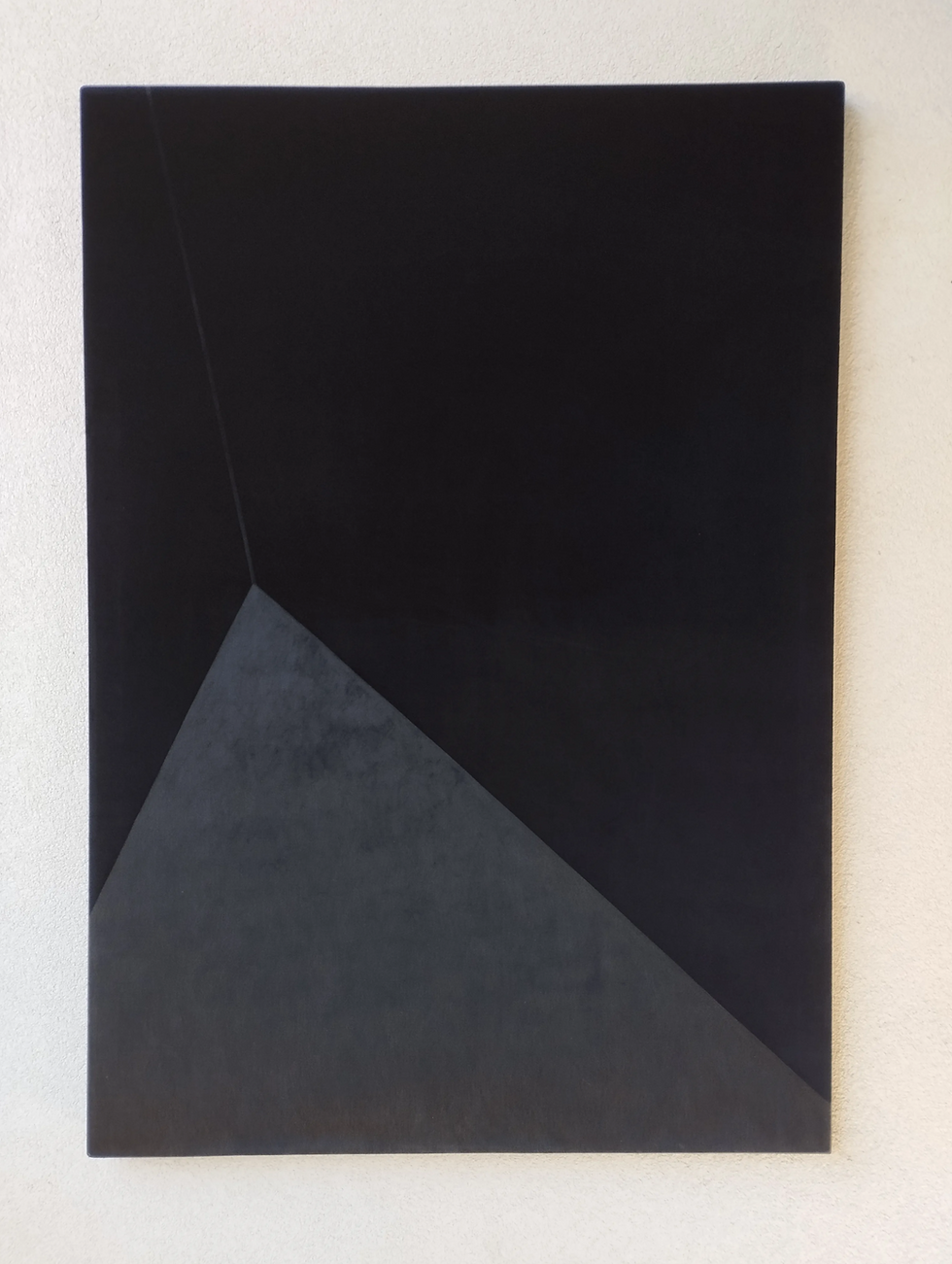


About the ACHROMATIC VELOUR PAINTINGS series:
The material used in this series of works is not typically painterly. By using plush as the basic foundation, it is positioned as a building element - the material is no longer just the basis of the painting, but becomes the primary surface of the object - the representation, with certain specificities (soft, smooth, shiny, solid...).
At the same time, the selected material, with minimal interventions, forms the basis of a system of geometric images - shapes that are consciously devoid of color (I use materials that are achromatic) and in such a reduced order of all formal elements, a relationship of rhythmic movements in relation to space is established. The abstract structure of geometric surfaces becomes a game - reflection, which moves from the "formed sign" to the "visual whole".
GEOMETRIZATIONS SERIES


About the GEOMETRIZATIONS series: The selection from the Geometrizations cycle consists of pictures - reliefs and pictures - drawings, shaped as integrated works that unite, not only technologically but also artistically, different experiences from several disciplines of artistic expression.
The very positioning of these works in the form of polyptychs creates a new system of interrelationships of horizontal and vertical sign structures and surfaces of different textures, which creates a unity of all elements. In this entire process, the material itself - terracotta relief, terracotta on canvas, graphite... is not only the basis for the image, but also becomes the primary surface of the object in the organized whole of the form.
The building elements are consciously reduced, where warm, natural materials contrast with dark surfaces and traces of graphite. By separating segments in the field of the whole and using linear-geometric construction, as well as "cuts" in the terracotta on canvas, I strive to form my own system - a symbolic code of the relationship between man and nature.

BOSILJKA ZIROJEVIC LECIC
REPRESENTED ARTIST
She graduated with a B.A. from the Academy of Arts in Novi Sad in 1994, specializing in the Painting Department. She later completed her postgraduate studies (M.A.) in the same department, graduating from the academy in 2000. That same year, she began working at the Academy of Arts in Novi Sad within the Department of Fine and Applied Arts. Currently, she serves as a Professor at the institution.
She has been a member of both the Association of Fine Arts in Vojvodina (ULUV) and the Serbian Association of Fine Arts (ULUS) since 1995. Additionally, she belongs to the art group Multiflex, where she collaborates with fellow artists on multimedia projects. Since 2022, she has also served as a permanent curator at the "Mitar Subotić Suba" Foundation.
Since 1992, she has participated in over 150 group exhibitions regionally and internationally, spanning countries such as Serbia, Poland, Italy, China, Germany, Japan, Switzerland, Great Britain, Austria, and France. Numerous fine arts critics have nominated her in various national artist selections within the contemporary art scene.
Throughout her career, she has held 27 solo exhibitions and received several awards for her work. These honors include the Special Award at the 6th "Salon for the Young Artists" Exhibition (Serbia, 1998) and the Annual Award for the best solo exhibition in the Gallery of the I. M. Kolarac Foundation in Belgrade (Serbia, 2001). That same year, she won an award at the 30th Artistic October Salon in Novi Sad. She went on to win awards at the 10th Exhibition of Drawings (Serbia, 2003) and the "30x30" Exhibition (Serbia, 2009). In 2011, she received the jury award at the 27th International Short Film Festival in Germany with the art group Multiflex, followed by the "Milivoj Nikolajevic" Award (Serbia, 2016).
She has coordinated numerous projects in art and education, while also participating in many international symposiums and conferences. Furthermore, she has served on several faculty and university boards, as well as councils for multiple art galleries.
Her academic work focuses on researching traditional and new visual media, exploring their parallels and intersections. The relationship between internal and external space is her primary field of exploration, where she examines the possibilities of expression and abstraction through diverse disciplines, including art, ecology, urbanism, and visual culture.