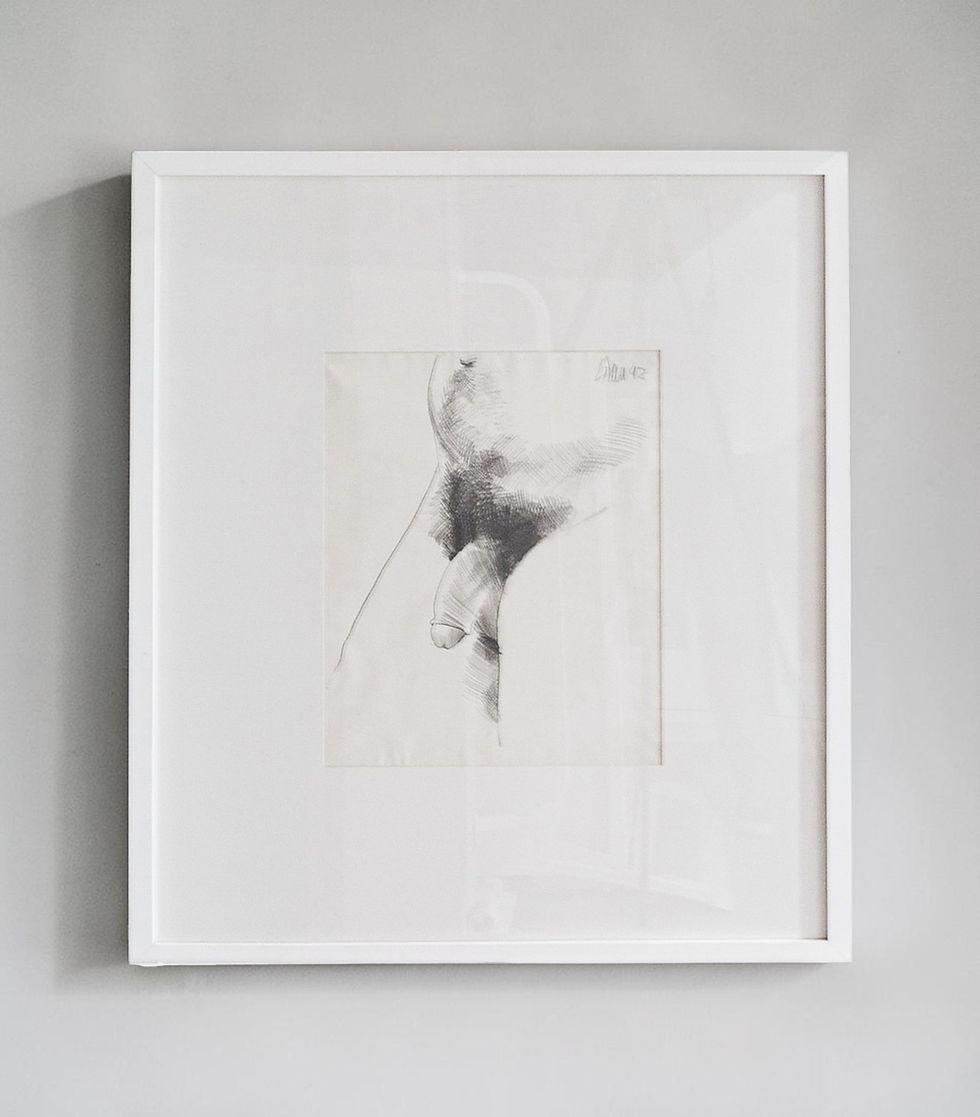
This remarkable 1984 work highlights the gestural freedom and personal intimacy characteristic of the Latin American master's mature period. Conceived as a figurative graphite drawing, the composition explores human anatomy through clean, decisive contours and rhythmic cross-hatching that builds volume and presence. The artwork’s provenance and historical significance are further elevated by a personal handwritten inscription from the artist ("Para Celso"), adding a rare biographical layer highly sought after by discerning collectors of works on paper. Presenting an exquisite balance between academic precision and modern expression, this piece is an extraordinary addition to contemporary and modern fine art collections.

Discover the timeless elegance of Untitled III, Nude drawing on paper, 1984 at theartdesignproject. This exquisite piece captures the beauty of the human form with delicate line work and a sense of intimacy characteristic of the era. As a contemporary art gallery in Miami, Florida, we are dedicated to promoting art and design by both established and emerging artists. Explore this compelling work that embodies the values of our gallery and provides an insightful glimpse into classic artistic expressions. Visit us to experience the meticulous craftsmanship and artistic excellence that define our curated collection.

Acquire the historic depth and elegant draftsmanship of this unique Enrique Grau artwork by purchasing this figurative graphite drawing online today.
Figurative graphite drawing - Untitled III 1984 by Enrique Grau
Untitled III, 1984
Graphite on paper
Dimensions:
Image size: 12 H x 9 W in.
Frame size: 18 H x 16.5 W x 1 D in.
Unique
Metal frame
Provenence Private Collection
Enrique Grau was born in Panama City and raised in Cartagena, Colombia. The Colombian government granted him a scholarship to attend the Art Students' League in New York from 1940 to 1943, where he studied painting with Harry Sternberg, Morris Kantor, and George Grosz. His subjects, mostly Amerindian and Afro-Columbian figures, can be divided into three phases: from the early 1950s, lyrical, Impressionistic forms; following his trip to Florence in 1954, cubist figures; and after 1957, classicized female portraits showing the influence of his colleague, Alejandro Obregón. The recipient of the coveted title Hijo Predileco de Cartagena de Indias (Favorite Son of Cartagena de Indias), he also won the National Prize in the 1959 Salon of Latin American Art, Cartagena. Both the Solomon R. Guggenheim Museum in New York and the Museum of Modern Art in Paris have held major exhibitions of his work. Shortly before his death in 2004, Grau donated to the city of Cartagena over 1300 of his artworks for a new museum.