This self-portrait addresses the turning-of-the-thirties crisis, serving as a reflection on the passage of time and the anticipation of an uncertain future. Painted at age 31, it shows the artist with a distant, faraway gaze. Queen Elizabeth I appears in reference to the Golden Age of her reign, which flourished during her mature years. On the other side, the Miss Universo building—an iconic architectural landmark of Barranquilla—and a purple oak flower (roble morado) stand as an allegory for youth lived in that city. The hanging dead hummingbird directly references Frida Kahlo’s Self-Portrait with Thorn Necklace and Hummingbird, symbolizing broken dreams, as hummingbirds are deeply connected to dreams in Mexican tradition. Upon the table, a scale represents the artist's zodiac sign, Libra, signifying a constant effort to keep everything balanced amidst the crisis. A nearby book features a detail of Leonora Carrington’s painting Samhain on its cover—a piece the artist considers a mirror of how people perceive his physical appearance in real life. Finally, just as Elizabeth I references other works in his collection, a rabbit and a cat appear in this piece as guardians, representing his artistic body of work, where they frequently serve as prominent protagonists.
Discover this watercolor on paper art by Andru Suarez Rojas to elevate your fine art collection.
Watercolor on paper. Self-portrait. The Golden age, 2025. By Andru Suarez Rojas
Self-portrait. The Golden age, 2025
From the More from this artist
Watercolor on paper
Dimensions: 8.6 H x 6.7 W in.
Signed lower front by the artist
Unframed
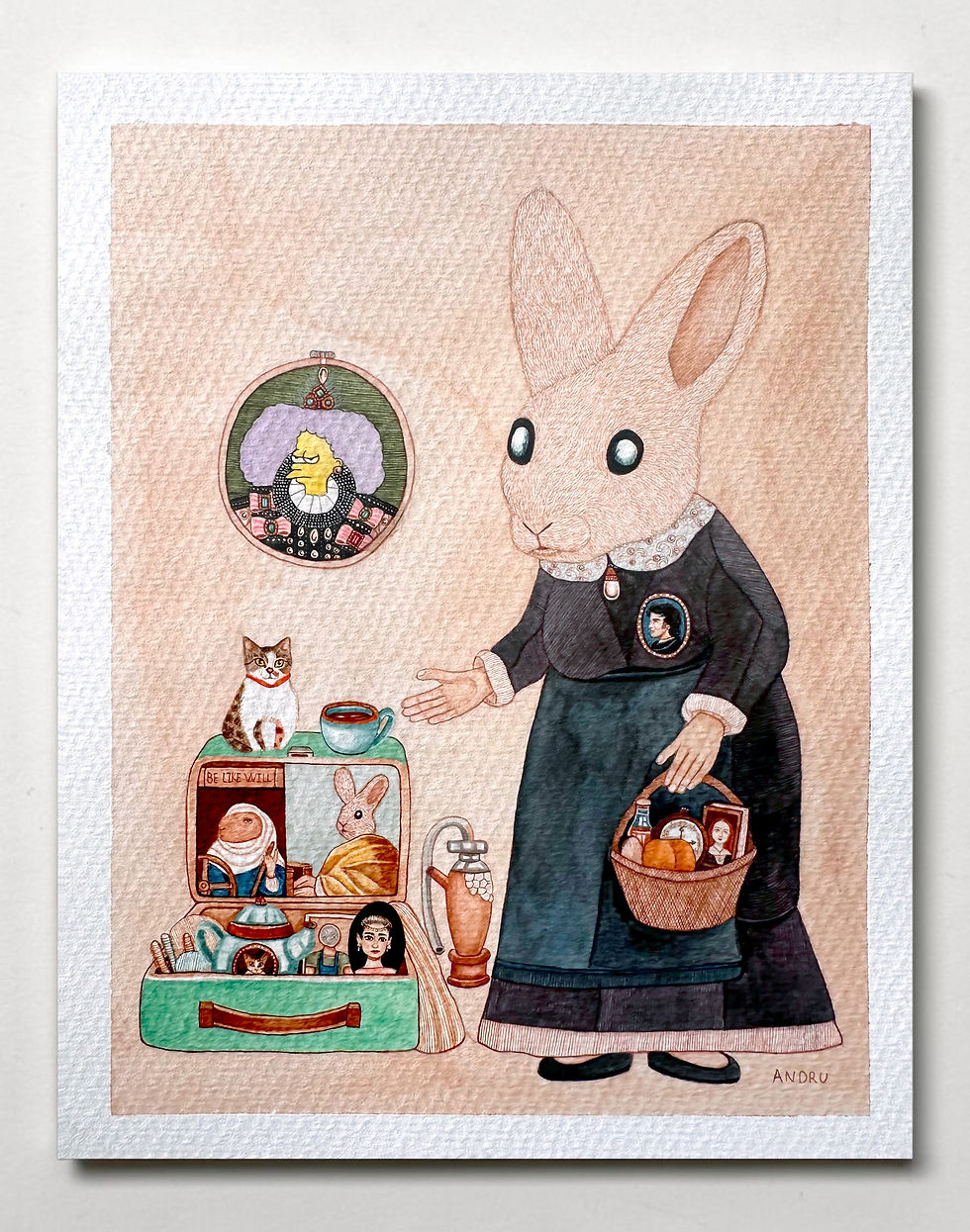
Andru Suárez Rojas (b. 1994, Barrancas, La Guajira, Colombia) is a contemporary artist whose work explores the concept of folklore through staged settings and compositions that interrogate identity, transvestism, and time.
Suárez Rojas creates dreamlike, "non-place" environments that evoke the human capacity for preserving histories and memories. His visual language is deeply influenced by the visionary legacy of Surrealist artists Leonora Carrington, Remedios Varo, and Frida Kahlo, seamlessly interwoven with the delicate watercolor sensibilities of British illustrator Beatrix Potter.
Literature and everyday scenes serve as foundational pillars for his compositions. Rather than drawing from modern pop culture, the artist's anthropomorphic creatures are rooted in ancient mythologies and folklore:
The Rabbits: While easily mistaken for references to Alice in Wonderland, their presence is intrinsically linked to the concept of transvestism. They find their origin in The Ballad of Mulan, the historic Chinese folk poem detailing a woman who disguises herself as a man to take her father's place in the military.
The Cats: These figures evoke the manifestation of the Egyptian goddess Bastet, acting as a bridge between distinct cultural traditions.
By positioning these symbolic animals within Victorian-inspired landscapes, Suárez Rojas engages in a deliberate process of aesthetic globalization and artistic hybridization. Furthermore, native South American animals, such as the capybara, appear sporadically throughout his work, embodying a sense of serene, quiet observation amidst these complex thematic dialogues.