
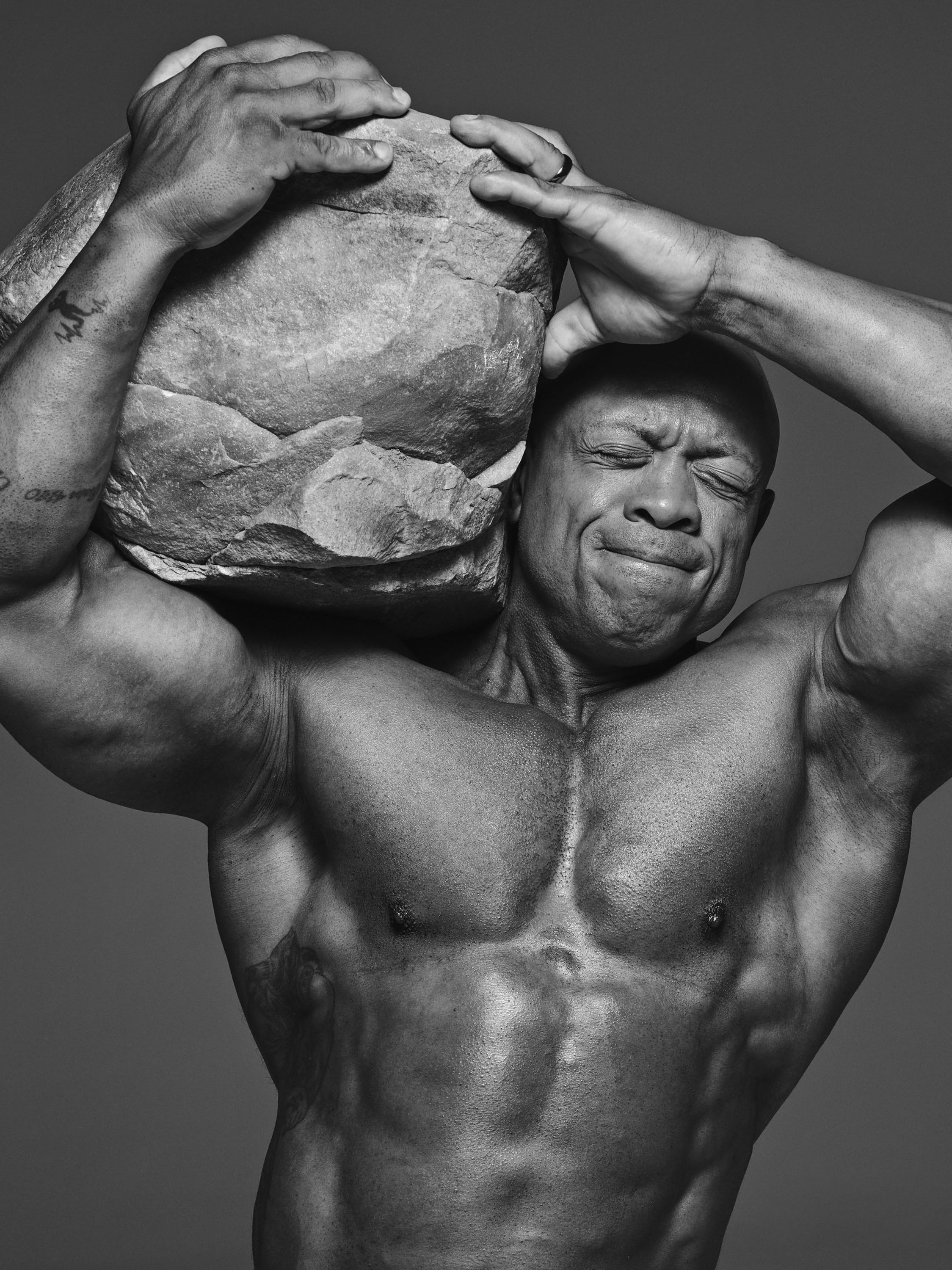

Tulio Pinto & Eduardo Rezende Gravitas explores the poetic tension between matter and body through the collaboration of sculptor Túlio Pinto and photographer Eduardo Rezende. The images transforms gravity from an invisible force into a visible, tangible experience. Divided into two acts — one photographic, one sculptural — the show reveals how weight, balance, and resistance shape both form and feeling. In Act I, Rezende’s black-and-white photographs place the body in dialogue with stone. His lens captures moments of strain and surrender, where hands and torsos yield to the mass pressing upon them. Departing from his fashion background,
Rezende celebrates vulnerability over perfection, turning the body into a living sculpture marked by gravity’s touch. In Act II, Pinto extends this dialogue into space, suspending heavy stones from fragile glass chains. The inversion of weight and fragility exposes the paradoxes of strength, trust, and material truth. Together, Pinto and Rezende dissolve boundaries between sculpture, performance, and photography.
Their collaboration invites viewers to not only see but feel gravity — its pull, its tension, its quiet authority. Gravitas ultimately becomes a meditation on what binds us to the ground and what allows us to rise against it: a study of balance, endurance, and the human spirit.  Discover the soul and depth of human expression with Figurative Photography at The Art Design Project.
Gravitas 19, 2025 by Tulio Pinto and Eduardo Rezende. Figurative Photography
Tulio Pinto & Eduardo Rezende
Gravitas 19, 2025
From the series Gravitas
Archival pigment print on canvas
Dimensions: 70.8 H × 53.1 W in
Edition of 5 + 1AP
Unframed
Exploring spatiality, Túlio Pinto’s (1974, Brasília, Brazil) works are situated between sculpture and installation and result in systems that develop the physical and visual capacities of matter. The concepts of balance and harmony permeate in a unique way the elaboration of each piece, where the tension between weights, sizes and densities formulate the coexistence of opposites such as rigidity and fragility, strength and resistance, balance and fall. Using materials such as concrete, iron sheets and glass, its production revolves around the concept of ephemerality and transformation that surround the relationship between bodies and space.
Eduardo Rezende (b. Rio de Janeiro, 1977) was introduced to art early in life through his mother, an art dealer. He began his career in photography in 2001 and has since developed a visual language defined by graphic precision, vibrant color, and a sculptural sensitivity to texture and form.


